



Rainwater Recycling With A Soakaway - How It Works
Rainwater recycling collects rain from your roof or hard surfaces, filters out the debris, stores it, then pumps it back out for purposes that don't need drinking-quality water. These include plant watering, car washing, flushing toilets, and feeding a washing machine. It cuts your mains use and your water bill. The catch is that recycled rainwater isn't potable, so it has to run on its own separate pipework, kept apart from your drinking supply.
It works just as well on a house as it does on a sports ground. The difference is mostly scale — and, as we'll get to, where you put the water once you've caught it.
Whilst modern soakaway crates are most commonly used for infiltration, where rainwater feeds into the soakaway structure and slowly filters back into the surrounding soil, they can also be used for rainwater recycling. This is a simple, environmentally friendly way to reduce water use whilst at the same time saving costs, and is a perfect fit for any modern sustainable drainage system (SuDS). This can work equally well for both domestic properties and commercial applications, such as sports fields.
How does rainwater recycling work?
Every system, domestic or commercial, runs the same five steps: collect, filter, store, pump, distribute. Rain runs off the roof into the gutters and down to a pre-filter that strips out leaves, grit and roof sediment. The clean water drops into a store. When you need it, a pump lifts it back out to wherever it's used. However, there are a few things people underestimate:
- First, filtration isn't one-size-fits-all — water destined for a washing machine needs a finer filter than water you're only ever going to spray on a lawn.
- Second, you still need a mains connection. No UK system collects enough to cover all your demand year-round, so the supply switches back to mains automatically when the store runs low.
- Because the recycled water is non-potable, Water Regulations require it on a dedicated, clearly separated pipe network so it can never cross-connect with drinking water.
That's the whole system. The part worth thinking hardest about is the storage.
Where is the rainwater stored?
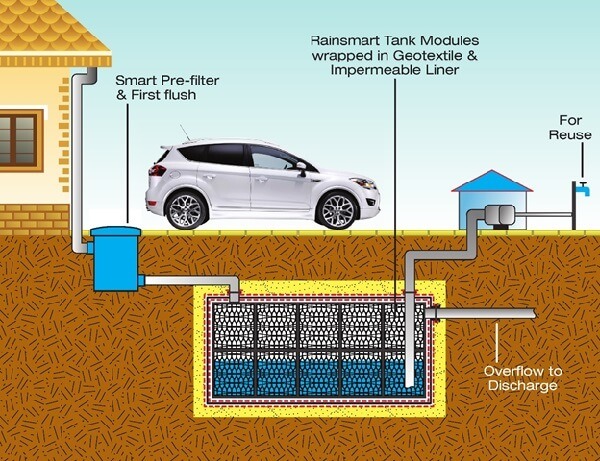
Historically, many domestic rainwater recycling systems will drop the rainwater into a holding tank buried in the garden or tucked beside the building. However, tanks have limits; they take up a fixed footprint, the buried ones need a sizeable excavation, and once you're storing larger volumes, the cost and the dig climb fast.
This is where soakaway crates come in as a storage solution rather than a tank. The crates can be wrapped in a standard geotextile membrane and a high-strength impermeable membrane to stop any water loss. Near the crate is sited a surface pump, which, as required, pumps the rainwater back out of the crate system for use in irrigation, car washing etc.
Compared to tanks, soakaway crates offer much more flexibility due to their modular nature, allowing you to create a tank of your desired shape and size. They are also highly likely to work out cheaper than a water storage tank.
Rainwater is fed in to recycling tank from rainwater pipes. It is held within the tank system by the membrane and drawn of as required via the pump. When the tank is full there is an overflow built in to the crate system which runs to a discharge point - a standard soakaway, surface water drain or watercourse.
How is sediment kept out of a water tank?
We would always recommend that you install a sediment trap prior to the recycling tank. This is a simple device that sits in line in the 110mm drainage pipe upstream from the soakaway and catches all of the dirt, grit and sediment that is washed off of the roof - you will be surprised how much of this there is.
Our silt traps are an excellent solution - installation is simple, and maintenance is merely removing the lid every three months or so and lifting out and emptying the silt bucket, then replacing it. The silt bucket even comes with a useful high handle attached to avoid the need to reach into the muddy water.
Commercial and large-scale rainwater recycling
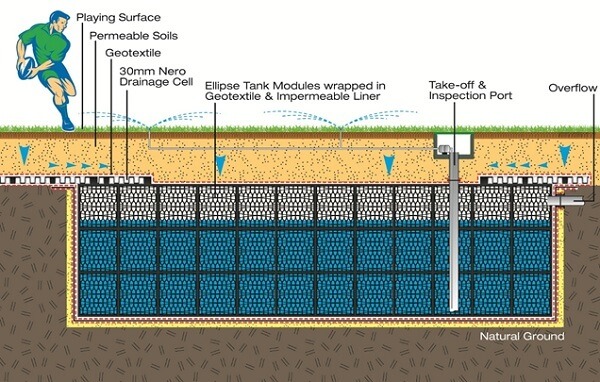
Areas such as sports fields use a huge amount of water in irrigation. Catching this water as it drains, collecting it and reusing is not only a sensible environmental solution, it also represents a huge cost saving. Water is collected by our Nero Drainage Cells over a wide area and channelled into collection points. These again are plastic soakaways wrapped in geotextile membrane and impermeable membrane to retain the water. This water is then pumped out of the crates as required for recycling. The diagram below explains this in detail.
If you would like further information about these products or if you would like us to assist with some design concepts, then please do not hesitate to contact us.
Items you will need
-
- Rainsmart 65 Tonne Soakaway Crate Set For Heavier Soils Assembled - 1 Cubic Metre Kit

- Code 80001M3
£407.60 £489.12 - Rainsmart 65 Tonne Soakaway Crate Set For Heavier Soils Flat-Packed - 1 Cubic Metre Kit

- Code 80001M3F
£378.48 £454.18 -
-
-
-
-