



What is an Attenuation Tank?
An attenuation tank is an underground store that holds rainwater from roofs, roads and car parks during heavy rain, then releases it slowly into a sewer or watercourse. By holding the water back and letting it out at a controlled rate, it stops a sudden downpour overwhelming the drains downstream and causing flooding. Most attenuation tanks are now built from plastic crates sealed inside an impermeable membrane.
How Does an Attenuation Tank Work?
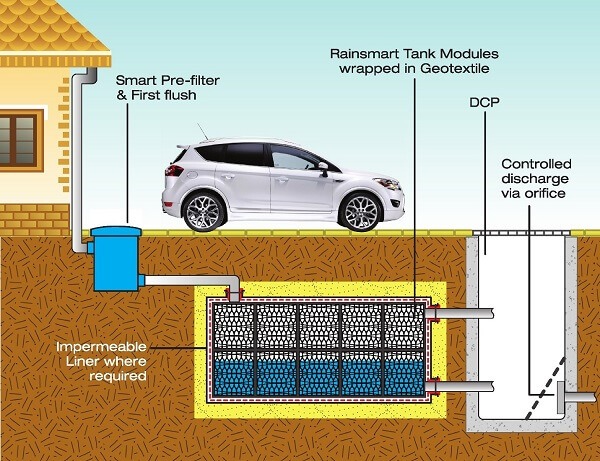
Every attenuation tank does the same four jobs, in this order:
- Filter - Rainwater runs first into a silt trap or catchpit, which catches silt and debris before it reaches the tank.
- Store - The water flows into a tank built from modular crates, sized to hold the volume of a heavy storm.
- Seal - The crates are wrapped in an impermeable membrane, so the water stays in the tank instead of soaking into the ground. The membrane comes on a roll or as a pre-made shoebox liner.
- Release - A flow control chamber on the outlet limits how fast water leaves the tank, so it drains into the surface water network at a safe, steady rate.
When the rain stops, the tank empties through the flow control, ready for the next storm.
 What is the Difference Between an Attenuation Tank and a Soakaway?
Both are often built from the same crates. The difference is where the water goes.
- A soakaway lets the water soak into the surrounding ground. The crates are wrapped in a permeable geotextile membrane, and there's no outlet. Read more in our guide to what a soakaway is.
- An attenuation tank holds the water and releases it through a controlled outlet. The crates are sealed in an impermeable membrane.
Attenuation is used where a soakaway won't work, such as in clay or other slow-draining ground, a high water table, contaminated land, or sites too close to buildings for water to soak away safely. Some systems combine the two, wrapping the tank in a geotextile membrane so some water soaks away and the rest leaves through the flow control.
What is a flow control?
The flow control is what turns a storage tank into an attenuation tank. It sits in a chamber downstream of the tank and restricts how fast water can leave. The most common types are:
- Orifice plates, a plate with a hole sized to let through a set flow. Our Oriflo flow control chambers use this method.
- Vortex flow controls, which use a spinning flow of water to hold back the discharge.
Sizing a flow control needs two figures: the design head (the maximum depth of water in the tank above the outlet) and the flow rate you're allowed to discharge, in litres per second. Our guide to flow controls explains both.
How Big does an Attenuation Tank Need to be?
Three things determine the size of an attenuation tank:
- The area draining into it. More roof and paving means more water to store.
- The storm it must cope with. Your local authority will normally set a design storm, often with an allowance for climate change.
- How fast you're allowed to discharge. The slower the permitted rate, the more water the tank has to hold while it drains.
On new developments in England, most local authorities work to Defra's non-statutory technical standards for sustainable drainage systems, which limit how fast a site can discharge compared with the land before it was built on. That makes attenuation tanks a design job: the volume and discharge rate normally come from a drainage engineer's calculations, approved by the council.
How Deep Should an Attenuation Tank be?
The depth depends on how many layers of crates are stacked, and how much cover goes over the top. Tanks under car parks and roads need heavy-duty crates and deeper cover. For car parks used by vehicles up to 9 tonnes, we recommend at least 1m of cover over our 65 tonne heavy crates. For HGV loads or deeper tanks, speak to us for advice on the right crate and cover depth.
Do Attenuation Tanks Need Maintenance?
Yes, but not much if the tank is designed so it can be reached:
- Empty the silt trap or catchpit regularly, so silt doesn't build up in the tank.
- Check the flow control chamber is clear. A blocked orifice will make the tank back up.
- Include an inspection channel and access chamber, so the tank can be jetted out if silt does get in.
Building an Attenuation Tank
Most attenuation tanks are built from soakaway crates, with an impermeable membrane, a silt trap and a flow control. Use heavy-duty crates under trafficked areas. Our impermeable membrane shoebox installation guide shows how the liner goes in. For housing plots, our plot attenuation systems come as complete kits.